Andrew Yeckel > Art Gallery > Mondrian Collection
Mondrian Collection
Everything shown here is Copyright © 2019 Andrew Yeckel, all rights reserved
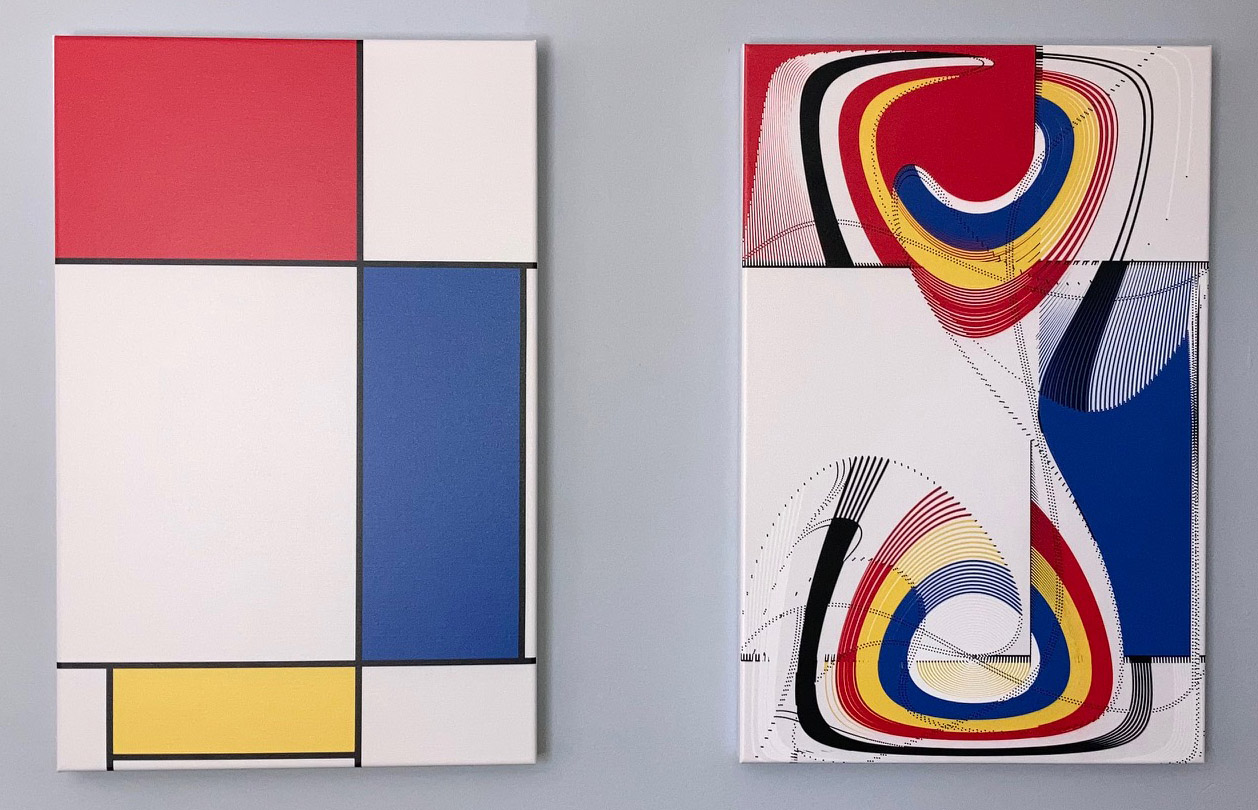
The upper left image, my knockoff*** of Piet Mondrian's 1928
painting, Large
Composition with Red, Blue, and Yellow,
represents the initial distribution of colored particles in a
box. The other images are generated by allowing this reference
image to mix for varying lengths of time when the top and
bottom walls are translated in opposite directions. When I
first started playing around with this concept, I made this
fun collection
of animations showing the mixing process.

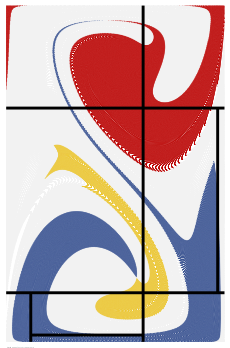

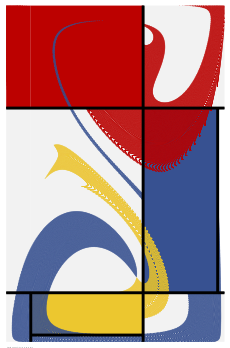

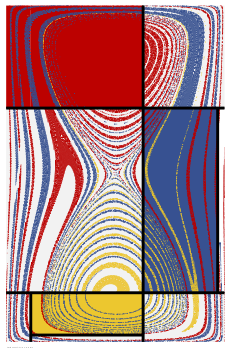


I've had the collection printed on 17 x 26 inch stretched canvases. For now they are stacked on this wall in my house, but I can imagine them strung out down a corridor in a hotel or commercial building:
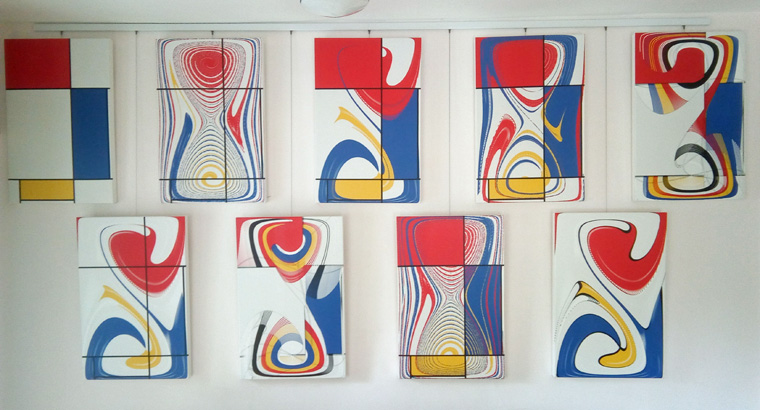
These also look good in a float frame:

They look good in pairs showing the reference image with its
derivative. These are hanging on Goodwin's office wall,
bringing an air of civilization to the place.
These images remain sharp at any enlargement. You need to see these canvases in person to fully appreciate them.
*** My copy differs from the original Mondrian in several ways: the black lines are uniform in width, the proportions of the color blocks are slightly different, the red and yellow hues are brighter, and the blue hue is somewhat duller.
How these were made
These pictures were made by computing particle pathlines in a closed box. Stokes flow is driven by lateral motion of the top and bottom surfaces, which creates a vortex pair having two lobes enclosed by a streamline in the shape of a figure eight or hourglass, as shown below. Strictly speaking the U velocity is parabolic rather than constant along the top and bottom surfaces. I do this to avoid a discontinuity at the corners. The result is a smoother flow better suited to this type of visualization.

Particles are colored to match the painting
wherever they are initially released into the flow. Particles
that are released within the lobes will remain trapped there,
and particles released outside the lobes will circulate around
the outside. We can see that the upper lobe encloses mostly
red with a little blue, and the lower lobe encloses nearly
equal amounts of blue and yellow. These ratios are preserved
throughout mixing.
Where did I get this idea?
When I was growing up I had a wonderful friend, Marty. Inside his family home there is a reproduction of a Mondrian painting that Marty's father painted sometime in the 1960s, Tableau No. IV - Lozenge Composition. I first saw this painting in 1973, soon after Marty and I met in junior high school.
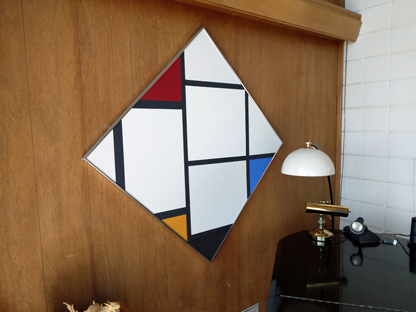
One day in 2018 we were back together again, visiting at his
family home. I had been showing off some of my pathline
animations before the conversation fell silent and we
drifted into our own thoughts. Then my eyes, wandering around
this scene where I spent many hours of my youth, fell upon
this painting once again. It wasn't so much a thought as it
was an image, like the proverbial light bulb over the head: I'm
going to shove that painting into a Cats2D simulation and
see what happens. Six months later I started the
Mondrian Project, as I began to call it. Instead of Tableau
IV, I chose a simpler painting with a conventional
orientation. It has turned out to be quite the playground.
Marty fell ill and passed away a year later. This artwork, and many other things, are daily reminders of the conversation we started nearly 50 years ago. That conversation continues on inside my head. He is still my counselor. I miss him very much.