Andrew Yeckel > Art Gallery > Mondrian Style
Mondrian's abstract works as figurative art
Everything shown here is Copyright © 2019-2022 Andrew Yeckel, all rights reserved, except as noted.
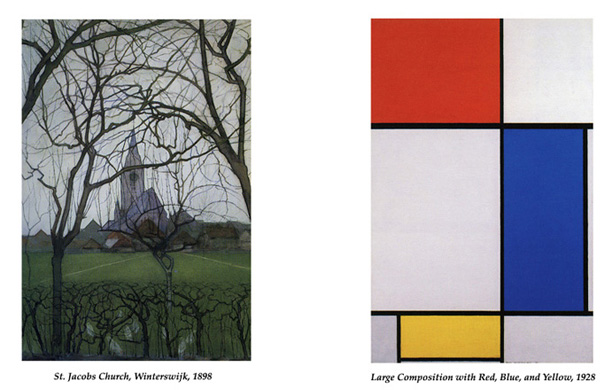
Mondrian began his career as a figurative painter. His early paintings include landscapes, portraits, and still lifes. An early work, from 1898, is shown on the left below. His style was influenced by impressionism and pointillism. Over the course of his career, his work evolved towards a style that was linear, abstract, and non-representational. This terminus is well illustrated by his 1928 work, Large Composition with Red, Blue, and Yellow, shown on the right below. This is the style Mondrian is famous for today.
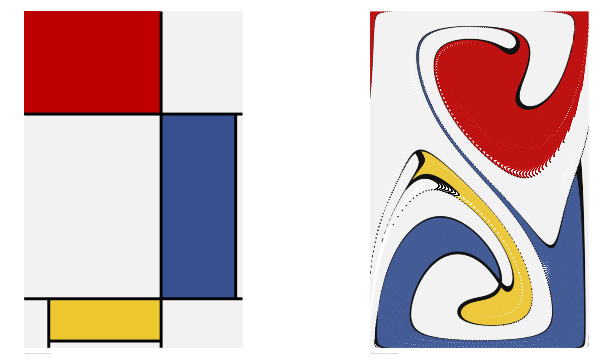
Mondrian's 1928 painting seems thoroughly abstract. My digital imitation of his painting, below left, is every bit as abstract, it would seem. So is the picture on the right, which resembles what might happen if we smeared a freshly painted Mondrian with our hands before the paint dried. The simple geometric forms used by Mondrian have been severely distorted to create an original artwork, but large blocks of primary colors separated by hard edges continue to evoke Mondrian's well known style.
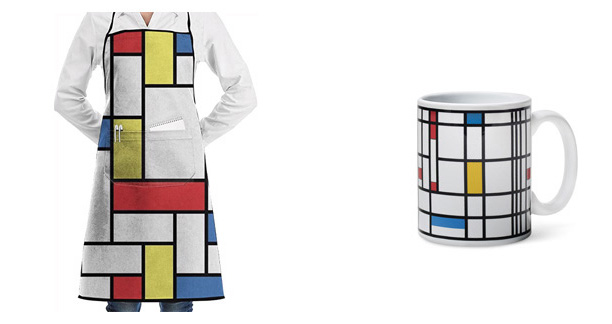
I find my picture aesthetically pleasing in abstract terms, but the work is also somewhat representational with its obvious reference to Mondrian's works. Consider how many people instantly recognize Mondrian's distinctive style, particularly through the proliferation of merchandise bearing likenesses of his work. They may not know his name, but they've seen work by "that guy" before. Our emotional response to a Mondrian copied onto a kitchen apron is different than our emotional response to an original Mondrian artwork. These are humorous references, sort of an inside joke for art lovers.
I like my picture with its obvious reference to Mondrian, but the concept I've discussed so far seems a bit thin: Start with a Mondrian, swirl it around to make some pretty whorls, and call it art. Maybe it will seem artistic if the whorls are executed skillfully enough, but maybe not. Anyone can splatter paint, but few can drip it onto a canvas with the skill of Jackson Pollock. But the process by which I transform an abstract Mondrian reference image into an accurate visualization of a stirred liquid carries it into a different realm. To me this art is every bit as figurative as it is abstract.

The longer the reference image is mixed, the more we perceive the characteristic "figure 8" shape of this type of flow as it superimposes itself on the geometric regularity of the Mondrian image. Had someone else made these pictures and shown them to me, I would have immediately recognized its similarity to an important class of flows in fluid mechanics. Below I show the effect of mixing a stratified liquid in a lid-driven cavity taken from my research. On the left is an initial distribution (color might represent salinity, for example), and on the right is the distribution after some time of mixing.
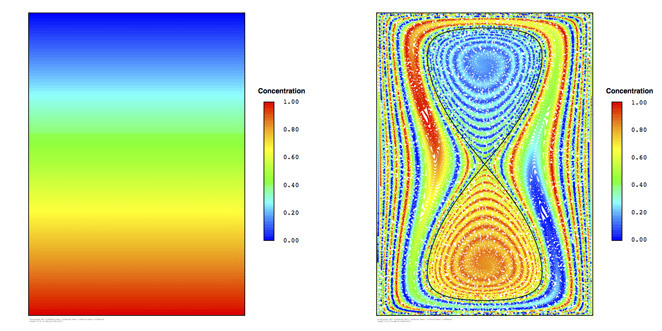
I made these images purely in the interest of a scientific
study, not with any intent to create an aesthetically
interesting picture. It was a small step from this work to my
Mondrian collection.
I wonder if Mondrian would have achieved nearly so much fame
had he appeared on the scene in the 1920s as an unknown artist
painting these highly abstract forms. Could he have built an
audience for these "simple" paintings without his reputation
as an accomplished landscape painter? The evolution from his
earlier, more conventional works to his later, more radical
works was somewhat gradual. Did this help Mondrian acclimate
his audience to the abstract direction he was headed, earning
their trust first? I tend to think so. This wasn't just some
unknown newcomer peddling these works; this was a well known,
accomplished painter who began to paint in this new and
radically different style.
The subjective aesthetic qualities of an artwork depend strongly on the context of the present moment, but also on the historical arc it travels before and after its creation. This art might have failed had it appeared out of nowhere, detached from this historical context. My reconstruction of Mondrian's abstract work as a physics-based simulation jumps onto this arc, a free rider of sorts, creating a relationship between my art and its viewer that would not otherwise exist.
If you aren't convinced that flow visualization constitutes figurative art, take a look at this example from my Vortex Street collection. The inset image in this next picture seems rather abstract, but it is drawn by an accurate simulation of perhaps the most recognizable phenomenon in fluid mechanics, the shedding of nearly parallel lines of vortexes in the wake behind a bluff body in a stream. The background image is a photograph of a flow visualization experiment of this same phenomenon, named the Kármán vortex street.
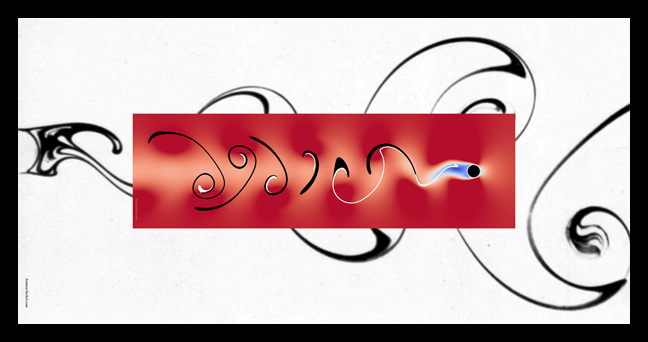
Anyone trained in fluid mechanics will recognize this
familiar physical phenomenon in any of the works in my Vortex
Street collection.